
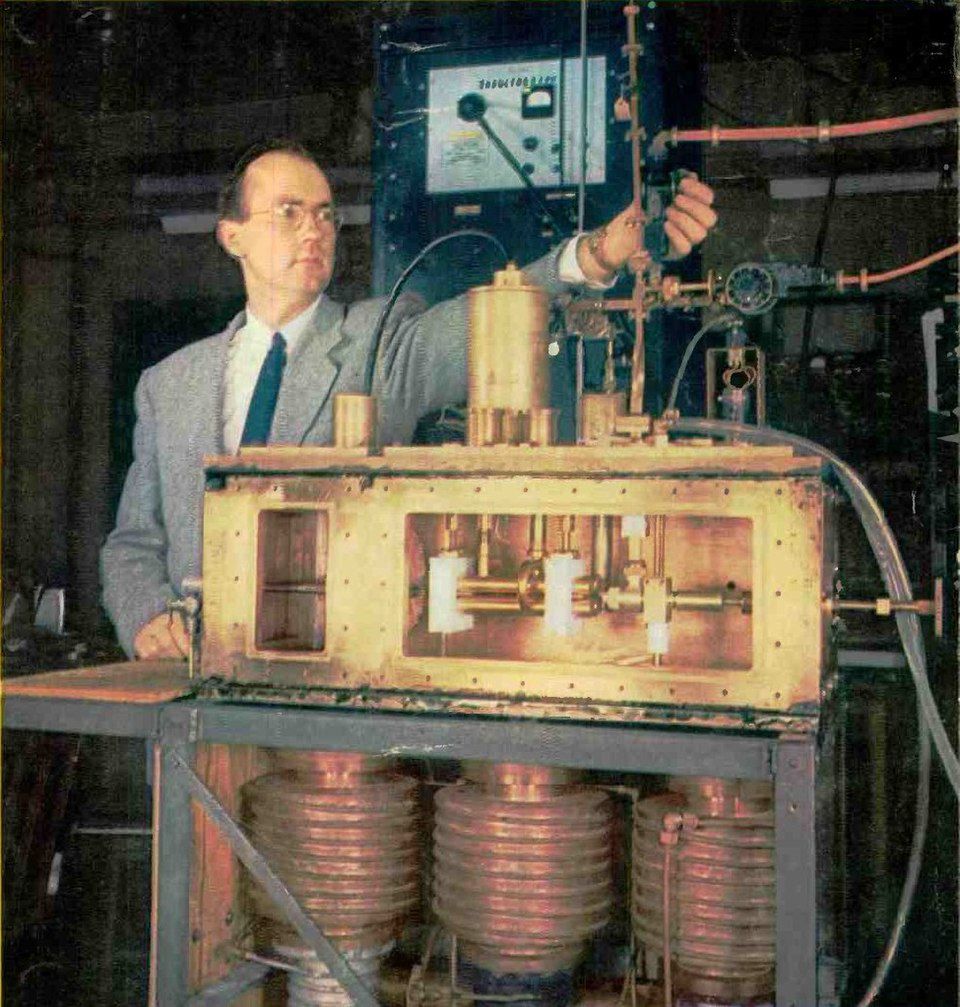
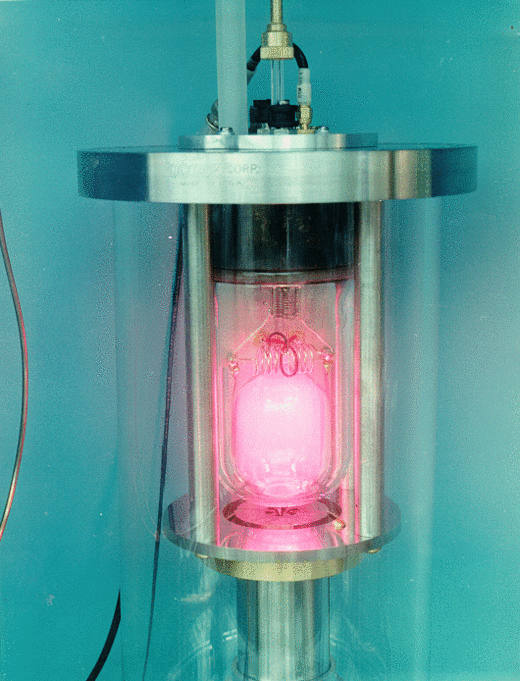
Imagine a device that can amplify weak microwave signals to incredible precision, revolutionizing our understanding of the universe. Meet the maser, a groundbreaking invention that produces coherent electromagnetic waves through stimulated emission.

The Birth of a Breakthrough
In 1952, pioneers Nikolay Basov, Alexander Prokhorov, and Joseph Weber introduced the concept of the maser. Just a year later, Charles H. Townes, James P. Gordon, and Herbert J. Zeiger successfully built the first maser at Columbia University.
Nobel-Winning Innovation
The maser’s impact was recognized globally when Townes, Basov, and Prokhorov were awarded the 1964 Nobel Prize in Physics for their theoretical work.
Applications that Shape Our World
Today, masers play a vital role in:
- Atomic Clocks: Providing precise timekeeping for scientific research and global navigation.
- Radio Telescopes: Amplifying faint signals from distant galaxies, helping us unravel the mysteries of the cosmos.
- Deep-Space Communication: Enabling spacecraft to transmit data back to Earth with unparalleled clarity.
The maser’s legacy continues to inspire innovation, pushing the boundaries of human knowledge and understanding.
*The Evolution of Maser Technology*
The maser concept has expanded beyond microwave frequencies, with modern designs generating electromagnetic waves at radio and infrared frequencies. This led Townes to suggest renaming the acronym to “maser” standing for “molecular amplification by stimulated emission of radiation”.
*The Maser-Laser Connection*
The maser paved the way for the laser, with both devices operating on the principle of stimulated emission. The laser produces higher-frequency coherent radiation at visible wavelengths. Key milestones include:
1. *Theoretical Foundations*: Townes and Arthur Leonard Schawlow’s work built upon maser research, laying the groundwork for the laser.
2. *The First Laser*: Theodore Maiman invented the laser in 1960.
3. *The “Optical Maser”*: Initially, the laser concept was referred to as the “optical maser” before being renamed.
*The Birth of the Laser Acronym*
Gordon Gould coined the term “laser” in 1957, standing for “light amplification by stimulated emission of radiation”. This marked a significant milestone in the development of laser technology.
*Types of Masers*

Some notable types of masers include:
1. *Atomic Beam Masers*: Utilize atomic beams to generate maser emission.
2. *Ammonia Maser*: Uses ammonia gas as the active medium.
3. *Hydrogen Maser*: Employs hydrogen atoms to produce precise frequency signals.
4. *Gas Masers*: Utilize gas as the active medium for maser emission.
5. *Solid-State Masers*: Use solid materials, like crystals, to generate maser emission.
*Recent Breakthrough
In the 21st century, researchers have made significant advancements:
1. *Room-Temperature Maser*: Developed in 2012, this solid-state maser operates at room temperature using pentacene-doped p-Terphenyl.
2. *Continuous-Wave Maser*: Demonstrated in 2018, this maser uses synthetic diamonds with nitrogen-vacancy defects to produce continuous-wave emission.
These developments showcase the ongoing innovation and potential applications of maser technology.
*Masers in Precision Applications*
Masers play a crucial role in:
1. *Atomic Frequency Standards*: Serving as high-precision frequency references in atomic clocks.
2. *Radio Telescopes*: Previously used as low-noise microwave amplifiers, masers enabled groundbreaking discoveries.
* Significance*Historical
In the 1960s, the Jet Propulsion Laboratory developed a maser for amplifying weak signals from deep space probes. This technology allowed for:
1. *Ultra-Low-Noise Amplification*: Enabling the reception of faint signals from space.
2. *Mariner IV Space Probe*: Successfully transmitting still pictures from Mars to Earth with a remarkably low transmitter power of 15 watts.
*Technical Achievements*
The maser system developed by JPL featured:
1. *Cryogenic Cooling*: Using liquid helium to chill the amplifier to 4 kelvin.
2. *Low Noise Figure*: Achieving a system noise temperature of 17 kelvin, allowing for exceptional signal clarity.
These advancements demonstrate the significant impact of maser technology on space exploration and scientific research.
*Hydrogen Maser: Atomic Frequency Standard*
The hydrogen maser is a crucial component of atomic frequency standards, contributing to the International Atomic Time standard (TAI). Here’s how it works:
1. *Atomic Hydrogen Beam*: A beam of atomic hydrogen is produced and state-selected to create a population inversion.
2. *Stimulated Emission*: Atoms in the upper energy level decay to the lower state, emitting microwave radiation.
3. *Microwave Cavity*: A high Q factor cavity confines and reinjects microwaves, amplifying the signal through stimulated emission.
4. *Frequency Stability*: The resonant frequency is tuned to 1,420,405,752 Hz, corresponding to the hyperfine energy transition of hydrogen.
*Signal Processing*
The maser signal is:
1. *Coupled into a Coaxial Cable*: A small fraction of the signal is extracted and sent to a coherent radio receiver.
2. *Amplified and Frequency-Converted*: The signal is amplified and its frequency changed using phase-locked loops and a high-performance quartz oscillator.
The hydrogen maser’s exceptional frequency stability makes it an essential component of atomic clocks and timekeeping systems.


💬 COMMENT