
A seismometer is a sensitive instrument that detects ground movements, such as those caused by earthquakes, volcanic eruptions, and explosions. When paired with a timing and recording device, it forms a seismograph, which produces a seismogram – a visual representation of the seismic data. This data is crucial for pinpointing earthquake locations, understanding their characteristics, and gaining insights into Earth’s internal structure.
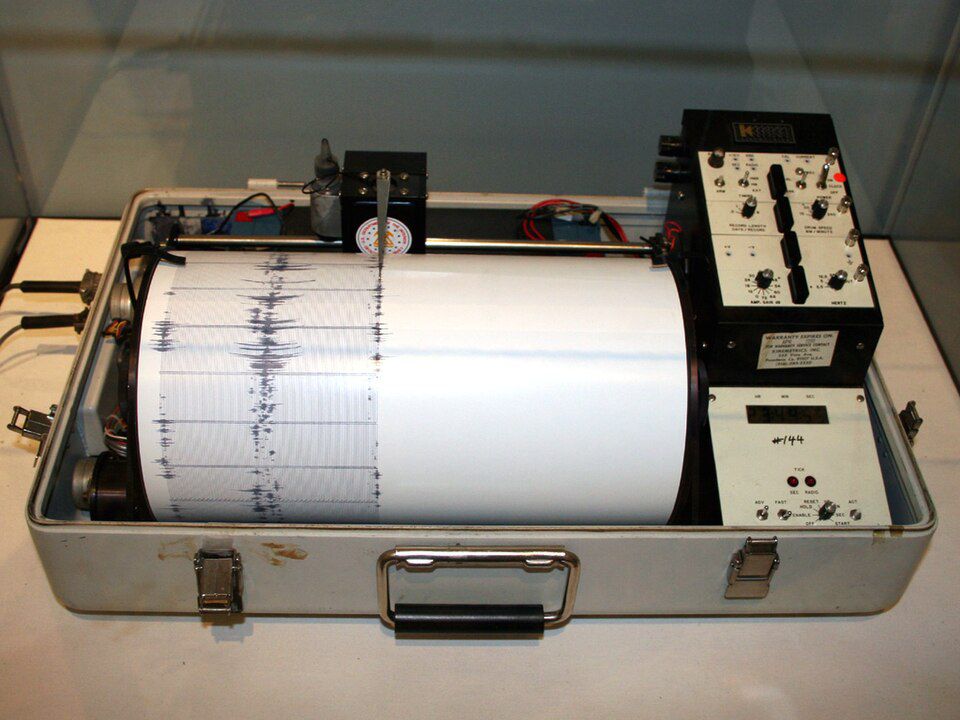
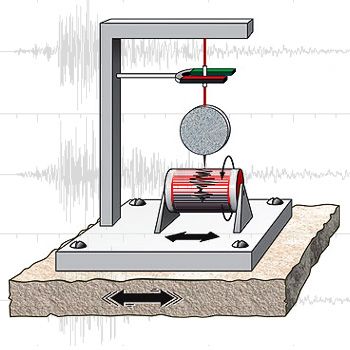
A simple seismometer, sensitive to up-down motions of the Earth, is like a weight hanging from a spring, both suspended from a frame that moves along with any motion detected. The relative motion between the weight (called the mass) and the frame provides a measurement of the vertical ground motion. A rotating drum is attached to the frame and a pen is attached to the weight, thus recording any ground motion in a seismogram.

Any movement from the ground moves the frame. The mass tends not to move because of its inertia, and by measuring the movement between the frame and the mass, the motion of the ground can be determined.
Early seismometers used optical levers or mechanical linkages to amplify the small motions involved, recording on soot-covered paper or photographic paper. Modern instruments use electronics. In some systems, the mass is held nearly motionless relative to the frame by an electronic negative feedback loop. The motion of the mass relative to the frame is measured, and the feedback loop applies a magnetic or electrostatic force to keep the mass nearly motionless. The voltage needed to produce this force is the output of the seismometer, which is recorded digitally.
In other systems the weight is allowed to move, and its motion produces an electrical charge in a coil attached to the mass which voltage moves through the magnetic field of a magnet attached to the frame. This design is often used in a geophone, which is used in exploration for oil and gas.
Seismic observatories usually have instruments measuring three axes: north-south (y-axis), east–west (x-axis), and vertical (z-axis). If only one axis is measured, it is usually the vertical because it is less noisy and gives better records of some seismic waves.[citation needed]
The foundation of a seismic station is critical.[2] A professional station is sometimes mounted on bedrock. The best mountings may be in deep boreholes, which avoid thermal effects, ground noise and tilting from weather and tides. Other instruments are often mounted in insulated enclosures on small buried piers of unreinforced concrete. Reinforcing rods and aggregates would distort the pier as the temperature changes. A site is always surveyed for ground noise with a temporary installation before pouring the pier and laying conduit. Originally, European seismographs were placed in a particular area after a destructive earthquake. Today, they are spread to provide appropriate coverage (in the case of weak-motion seismology) or concentrated in high-risk regions (strong-motion seismology).[3]
How Seismometers Work
A basic seismometer detects vertical ground motions using a weight suspended from a spring within a frame. As the ground moves, the frame moves too, while the weight remains relatively still due to inertia. This relative motion is recorded as a seismogram, providing a measurement of the ground’s movement.
Recording Ground Motion
In traditional seismometers, a pen attached to the weight recorded ground motion on a rotating drum. Modern seismometers use electronics to measure the motion between the weight and frame. Some systems use a feedback loop to keep the weight motionless, while others allow it to move, generating an electrical charge.
Types of Seismometers
There are different designs, including:
Geophones: used in oil and gas exploration, which measure ground motion using a coil and magnet.
Three-axis seismometers: measure ground motion in three directions (north-south, east-west, and vertical).
Seismic Station Setup
A seismic station’s foundation is crucial. Professional stations are often mounted on bedrock or in deep boreholes to minimize noise and thermal effects. Instruments are typically placed in insulated enclosures on small, buried concrete piers. Site surveys are conducted before installation to ensure optimal placement.
Seismometer Placement
Seismometers are strategically placed to provide coverage or focus on high-risk regions. While they were once placed in areas after destructive earthquakes, they are now spread out to capture a range of seismic activity.
history and evolution of seismometers:
Early Seismometers
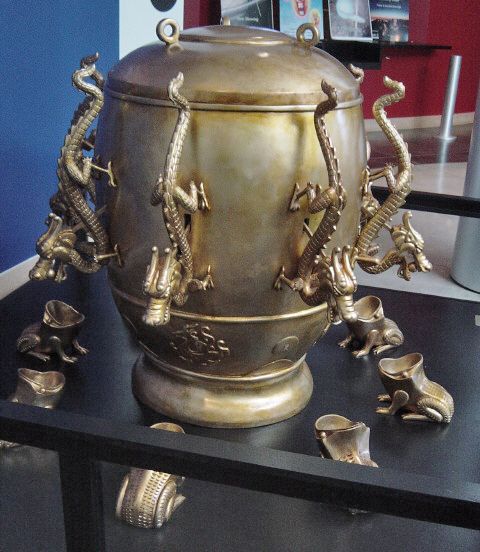
Ancient China: Zhang Heng, a mathematician and astronomer, invented the first seismoscope in the 2nd century AD. This device detected earthquakes and indicated the direction of the quake.
Western World: Jean de Hautefeuille, a French physicist and priest, described a seismoscope in 1703, using a bowl filled with mercury that would spill into receivers to detect earthquakes.
Modern Seismometers
19th Century: The modern seismometer was developed during this time, with significant contributions from scientists like John Milne, James Alfred Ewing, and Thomas Gray.
Key Innovations:
Horizontal Pendulum Seismometer: Developed by Milne, Ewing, and Gray in the 1880s, this design measured horizontal motion and paved the way for modern seismometers.
Broadband Seismographs: Modern seismometers can record a wide range of frequencies, providing detailed information about seismic activity.
Seismometers in Space Exploration
Moon: Seismometers were deployed on the Moon starting in 1969 as part of the Apollo Lunar Surface Experiments Package.
Mars: In December 2018, the InSight lander deployed a seismometer on Mars, marking the first time a seismometer was placed on another planet’s surface ¹.


💬 COMMENT