
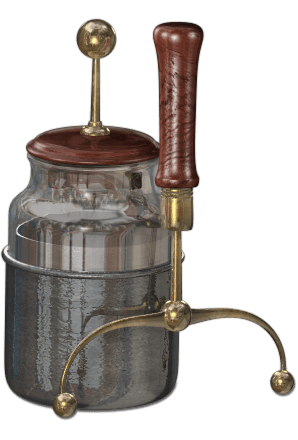
A Leyden jar is an electrical device that stores high-voltage electric charge between two conductors on the inside and outside of a glass jar. It consists of a glass jar with metal foil attached to its inner and outer surfaces, and a metal terminal that protrudes through the lid to connect with the inner foil.
Invention and History


The Leyden jar was independently invented by German cleric Ewald Georg von Kleist in October 1745 and Dutch scientist Pieter van Musschenbroek in 1745-1746. This groundbreaking device played a crucial role in early electrical experiments and was fundamental to the study of electrostatics.
Significance and Legacy
The Leyden jar was the first device capable of accumulating and storing large amounts of electric charge, allowing scientists to discharge it at will. This innovation overcame significant limitations in early electrical research and paved the way for further discoveries. Today, Leyden jars are still used in educational settings to demonstrate electrostatic principles.
: The Leyden Jar: A Pioneering Electrical Component A Leyden jar is an electrical device that stores high-voltage electric charge between two conductors on the inside and outside of a glass jar. It consists of a glass jar with metal foil attached to its inner and outer surfaces, and a metal terminal that protrudes through the lid to connect with the inner foil. Invention and History The Leyden jar was independently invented by German cleric Ewald Georg von Kleist in October 1745 and Dutch scientist Pieter van Musschenbroek in 1745-1746. This groundbreaking device played a crucial role in early electrical experiments and was fundamental to the study of electrostatics. Significance and Legacy The Leyden jar was the first device capable of accumulating and storing large amounts of electric charge, allowing scientists to discharge it at will. This innovation overcame significant limitations in early electrical research and paved the way for further discoveries. Today, Leyden jars are still used in educational settings to demonstrate electrostatic principles.
In the late 18th century, the Leyden jar was used in electrotherapy to treat various diseases with electric shock. By the mid-19th century, its operation was widely understood, and it became a common reference point.
Advancements in Radio Technology
The early 20th century saw the rise of radio technology, driving innovations in Leyden jar design. Improvements included:
Miniaturization
Reduced inductance and resistance
Better dielectric materials
These advancements transformed the Leyden jar into the modern compact capacitor, paving the way for further technological progress.
The Leyden jar’s evolution showcases its significant impact on the development of electrical technology, from early experiments to modern applications.
: The Leyden Jar’s Impact on Medicine and Technology In the late 18th century, the Leyden jar was used in electrotherapy to treat various diseases with electric shock. By the mid-19th century, its operation was widely understood, and it became a common reference point. Advancements in Radio Technology The early 20th century saw the rise of radio technology, driving innovations in Leyden jar design. Improvements included: Miniaturization Reduced inductance and resistance Better dielectric materials These advancements transformed the Leyden jar into the modern compact capacitor, paving the way for further technological progress. The Leyden jar’s evolution showcases its significant impact on the development of electrical technology, from early experiments to modern applications.


💬 COMMENT