
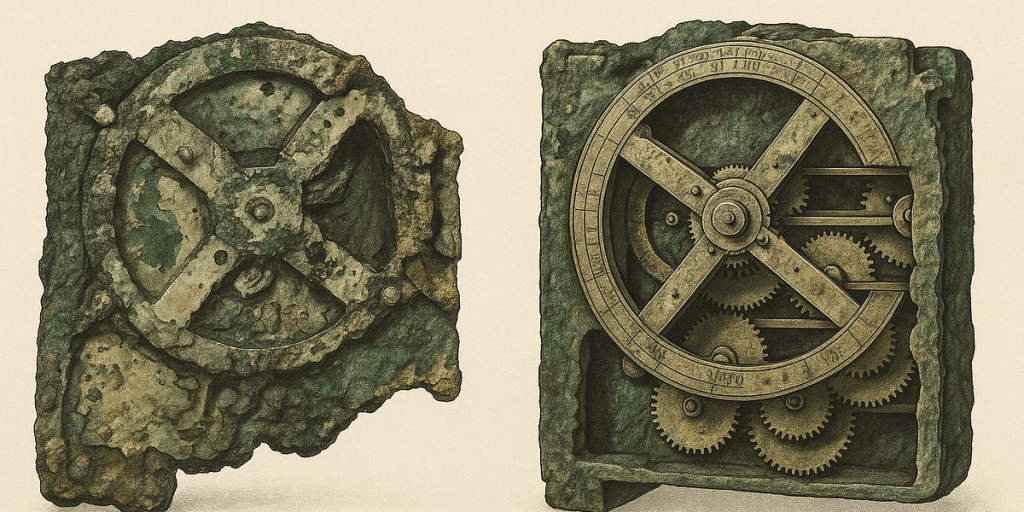
From the sun-drenched depths of the Aegean Sea, a relic emerged that continues to astound and bewilder scientists: the Antikythera Mechanism. Discovered amongst a shipwreck off the coast of the Greek island of Antikythera in 1901, this corroded collection of bronze gears and dials initially appeared unremarkable. Yet, as researchers painstakingly pieced together its fragments, they unearthed a device of such complexity and sophistication that it challenged our understanding of ancient technology, revealing a level of astronomical and mechanical knowledge previously attributed only to much later periods.
Often hailed as the world’s first analogue computer, the Antikythera Mechanism is far more than a simple astronomical calculator. It was a portable planetarium, a mechanical marvel designed to predict celestial phenomena with remarkable accuracy. Imagine, over two millennia ago, an artisan crafting a device capable of tracking the movements of the Sun and Moon, predicting lunar and solar eclipses, and even accounting for the elliptical orbit of the Moon, a concept not fully understood by European astronomers until the 17th century.
A Puzzle of Bronze and Time:
The mechanism, originally housed in a wooden box roughly the size of a shoebox, is comprised of at least 30 intricate bronze gears meshing together with astonishing precision. These gears, some with teeth as small as a millimeter, are adorned with inscriptions in ancient Greek, providing crucial clues to the device’s function.
For decades, the true purpose of the Antikythera Mechanism remained shrouded in mystery. Early theories suggested it might be an astrolabe, a navigational instrument. However, as X-ray and tomographic imaging techniques advanced, revealing the hidden inner workings and the complex relationships between the gears, a far more profound picture began to emerge.
Decoding the Celestial Dance:
Modern research has conclusively demonstrated that the Antikythera Mechanism was designed to model the cosmos as understood by the ancient Greeks. It could:
* Predict Solar and Lunar Eclipses: By turning a hand crank, users could advance or reverse time and witness the predicted occurrences of eclipses, complete with indications of the time of day and the zodiacal sign in which they would occur.
* Track the Phases of the Moon: A dedicated dial displayed the lunar phases with surprising accuracy, even accounting for the Moon’s irregular orbit.
* Chart the Movements of Planets: Inscriptions suggest that the mechanism also tracked the movements of the five planets known to the ancient Greeks – Mercury, Venus, Mars, Jupiter, and Saturn – though the evidence for the complete planetary system within the surviving fragments is still being pieced together.
* Indicate Calendrical Cycles: The device incorporated cycles such as the Metonic cycle (a 19-year cycle aligning lunar and solar years) and the Saros cycle (an approximately 18-year cycle for predicting eclipses), demonstrating a deep understanding of long-term astronomical patterns.
* Potentially Display Other Astronomical Information: Fragments bear inscriptions related to the constellations and potentially other celestial events, hinting at even broader capabilities.
A Testament to Ancient Ingenuity:
The level of engineering and astronomical knowledge embodied in the Antikythera Mechanism is truly astounding. The precision of the gears, the complexity of the gear trains, and the sophisticated understanding of celestial mechanics required to design such a device far surpassed anything previously known from that era. It raises fundamental questions about the technological capabilities of the ancient world and suggests that a sophisticated tradition of mechanical engineering may have existed, only to be lost or interrupted by historical events.
Who Built This Marvel? And Why?
The identity of the creator and the precise purpose of the Antikythera Mechanism remain subjects of ongoing debate. Several theories have been proposed, linking it to renowned figures like Archimedes or his school, or perhaps to astronomical centers like Rhodes, which had a strong tradition in astronomy and mechanics.
The intended audience and use of the device are also unclear. Was it a scientific instrument for astronomical research? A teaching tool for demonstrating cosmic principles? Or perhaps a sophisticated device for astrological predictions? Its intricate nature suggests it was likely a high-status object, possibly commissioned by a wealthy individual or institution.
Echoes Across Time:
The Antikythera Mechanism stands as a powerful reminder that technological progress is not always a linear upward trajectory. Its existence forces us to reconsider our assumptions about the capabilities of ancient civilizations and highlights the fragility of knowledge. The rediscovery and ongoing study of this “ancient computer” continue to inspire awe and drive research into the history of science and technology. It serves as a testament to the boundless curiosity and ingenuity of the human mind, a silent oracle from the depths of time whispering secrets of a forgotten age of mechanical brilliance. As researchers continue to analyze its fragments and decipher its inscriptions, we can only anticipate further revelations about this extraordinary artifact and its place in the history of human innovation.


💬 COMMENT