
For centuries, our understanding of the universe was built on a foundation of classical physics, a world of predictable certainty. A ball thrown follows a parabolic arc, a planet orbits the sun with unwavering regularity, and the position and momentum of every object can be known with perfect precision. But at the turn of the 20th century, a new and startling reality began to emerge from the subatomic realm, a reality governed by a different set of rules – the rules of quantum mechanics.
Quantum mechanicsm is not just an extension of classical physics; it is a fundamental re-imagining of the universe at its most microscopic level. It describes a world where particles are not just solid, miniature objects, but also waves of probability. It’s a world where an electron can be in multiple places at once, and where observing a system can fundamentally change its properties. While it may sound like science fiction, quantum mechanics is the most thoroughly tested and successful theory in the history of science, underpinning technologies from lasers and transistors to magnetic resonance imaging (MRI).
The Quantum Leap: The Birth of a New Physics
The seeds of quantum mechanics were sown in the late 19th and early 20th centuries as physicists grappled with phenomena that classical physics couldn’t explain. Max Planck’s work on black-body radiation introduced the revolutionary idea that energy is not continuous but exists in discrete packets, or “quanta.” Albert Einstein later built on this concept to explain the photoelectric effect, showing that light itself is composed of these quanta, which he called photons.
The true paradigm shift, however, came with the work of pioneers like Niels Bohr, Werner Heisenberg, and Erwin Schrödinger. Bohr’s model of the atom proposed that electrons orbit the nucleus in specific, quantized energy levels, and that they “jump” between these levels by absorbing or emitting photons. Heisenberg’s Uncertainty Principle delivered a powerful blow to classical determinism, stating that it’s impossible to simultaneously know both the exact position and momentum of a particle with perfect accuracy.
Perhaps the most famous and unsettling concept came from Erwin Schrödinger’s equation, which describes the state of a quantum system. The solution to this equation is not a fixed position, but a “wave function” that represents the probability of finding a particle in a given location. This probabilistic nature is at the heart of quantum mechanics, a departure from the absolute certainty of classical physics.
The Bizarre and Beautiful World of Quantum Mechanics
Quantum mechanics introduces several mind-bending concepts that challenge our everyday intuition:
* Wave-Particle Duality: Quantum particles, like electrons and photons, exhibit a perplexing dual nature. In some experiments, they behave like particles, localized points in space. In others, they behave like waves, spreading out and interfering with each other. This duality is not a contradiction but a fundamental property of the quantum world.
* Quantum Superposition: One of the most counterintuitive ideas is that a particle can exist in a superposition of multiple states simultaneously. The famous “Schrödinger’s cat” thought experiment illustrates this perfectly: a cat in a box, whose fate is tied to a quantum event, is considered both alive and dead at the same time until the box is opened and its state is observed.
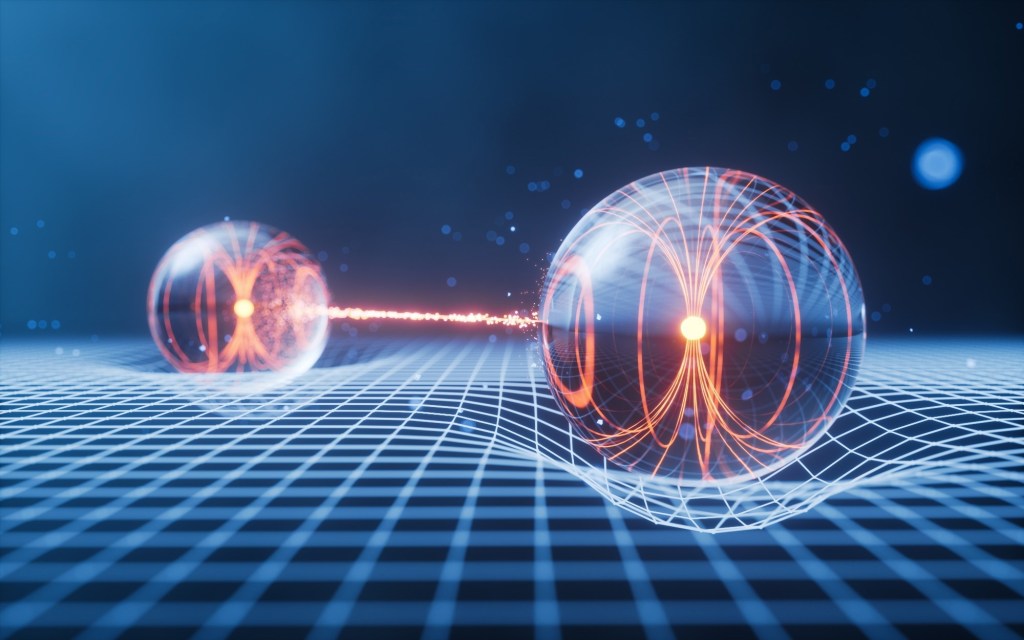
* Quantum Entanglement: This phenomenon, dubbed “spooky action at a distance” by Einstein, describes two or more particles that are linked in such a way that the state of one instantaneously affects the state of the other, regardless of the distance separating them. Measuring a property of one entangled particle instantly determines the corresponding property of the other, seemingly defying the speed of light.
From Theory to Technology: The Quantum Revolution
While quantum mechanics may seem like a purely abstract and theoretical field, its impact on modern technology is immense. The understanding of quantized energy levels led to the invention of the laser, a device that generates a highly focused beam of light. The principles of quantum mechanics are essential for designing and manufacturing the transistors that power every computer and smartphone. MRI machines, which create detailed images of the human body, rely on the quantum property of nuclear spin.
Today, we stand on the cusp of a second quantum revolution. Researchers are actively exploring the potential of quantum computers, devices that would harness superposition and entanglement to perform calculations that are impossible for even the most powerful classical computers. These quantum computers could revolutionize fields like materials science, drug discovery, and artificial intelligence.
In conclusion, quantum mechanics is more than just a theory; it is a profound journey into the fundamental nature of reality. It reveals a universe that is far more strange, beautiful, and interconnected than we ever imagined. As we continue to delve into the unseen world of the very small, we gain not only a deeper understanding of the cosmos but also the tools to build a future shaped by the astonishing power of the quantum.


💬 COMMENT