

*Introduction*
Black holes and dark matter are two of the most enigmatic and fascinating phenomena in the universe. These cosmic mysteries have captivated scientists and the public alike, sparking intense curiosity and debate. In this expanded article, we’ll delve deeper into the nature of black holes and dark matter, exploring their characteristics, implications, and the ongoing quest to understand these cosmic enigmas in greater detail.
*What are Black Holes?*
Black holes are regions in space where the gravitational pull is so strong that nothing, including light, can escape. They form when massive stars collapse, creating a singularity – a point of infinite density and zero volume. Black holes come in various sizes, from stellar-mass black holes (formed from star collapse) to supermassive black holes (residing at galaxy centers, with masses millions or billions of times that of the sun).
*Characteristics of Black Holes:*
1. *Event Horizon*: The point of no return around a black hole, marking the boundary beyond which nothing can escape.
2. *Gravitational Pull*: The incredibly strong gravity warps space-time, affecting nearby matter and energy.
3. *Singularity*: The core of a black hole, where density and curvature are infinite.
4. *Types of Black Holes*: Stellar-mass, intermediate-mass, and supermassive black holes, each with distinct formation mechanisms and properties.
5. *Observational Evidence*: Black holes are detected through their gravitational effects on nearby stars, X-ray emissions from accretion disks, and gravitational wave signals from mergers.
*What is Dark Matter?*
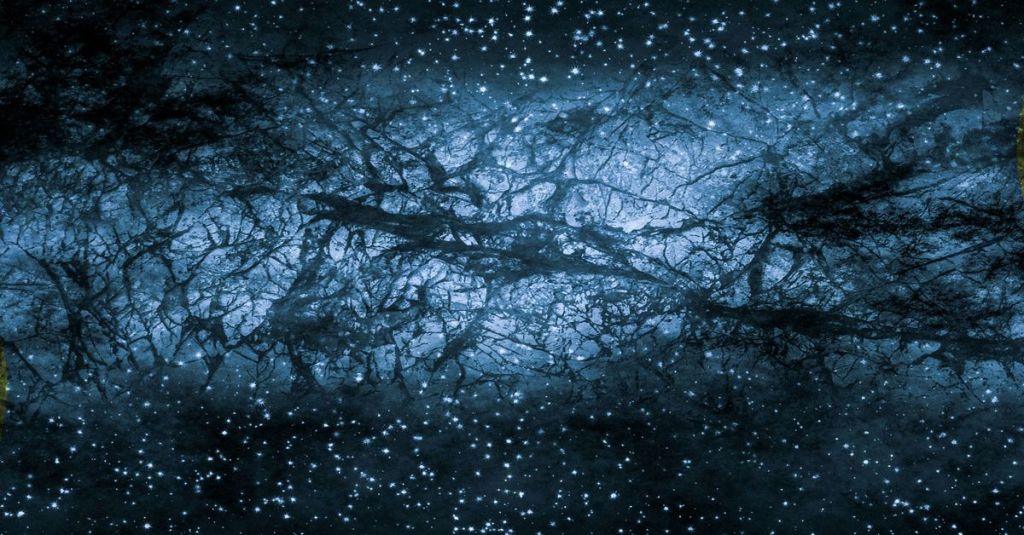
Dark matter is a mysterious, invisible form of matter that doesn’t emit, absorb, or reflect light, making it undetectable by conventional telescopes. Despite its elusive nature, dark matter’s presence is inferred through its gravitational effects on visible matter and the large-scale structure of the universe.
*Characteristics of Dark Matter:*
1. *Invisible*: Dark matter doesn’t interact with light, rendering it invisible to traditional detection methods.
2. *Gravitational Influence*: Dark matter’s gravitational effects shape galaxy rotation curves and the distribution of galaxy clusters.
3. *Unknown Composition*: The exact nature of dark matter remains unknown, with candidates including WIMPs (Weakly Interacting Massive Particles) and axions.
4. *Cosmological Role*: Dark matter plays a crucial role in the formation and evolution of galaxies, influencing the distribution of visible matter.
5. *Detection Methods*: Scientists employ various methods to detect dark matter, including direct detection experiments, indirect detection through gamma-ray signals, and collider searches.
*The Connection Between Black Holes and Dark Matter*
While black holes and dark matter are distinct phenomena, they are interconnected in the cosmic landscape. Dark matter can influence the formation and growth of black holes, and supermassive black holes can, in turn, affect the distribution of dark matter within galaxies. This interplay is crucial for understanding galaxy evolution and the co-evolution of black holes and their host galaxies.
*Ongoing Research and Mysteries*
The study of black holes and dark matter is an active area of research, with scientists employing cutting-edge technologies and theories to unravel these mysteries. Key questions remain, such as:
– What is the exact composition of dark matter?
– How do supermassive black holes form and grow?
– What lies at the singularity within a black hole?
– How do black holes and dark matter interact in the early universe?
*Theoretical Models and Simulations*
To address these questions, researchers rely on theoretical models and simulations, which help predict the behavior of black holes and dark matter in various astrophysical contexts. These models are continually refined as new observational data and theoretical insights become available.
*Future Prospects and Missions*
Upcoming missions and facilities, such as the James Webb Space Telescope, the Square Kilometre Array, and the Laser Interferometer Space Antenna, will provide unprecedented opportunities to study black holes and dark matter in greater detail. These advancements will likely shed new light on the mysteries surrounding these cosmic phenomena.
🌟 *Summary:* Black holes and dark matter are two cosmic enigmas that continue to fascinate and intrigue. Understanding these phenomena is crucial for unlocking the secrets of the universe.


💬 COMMENT