
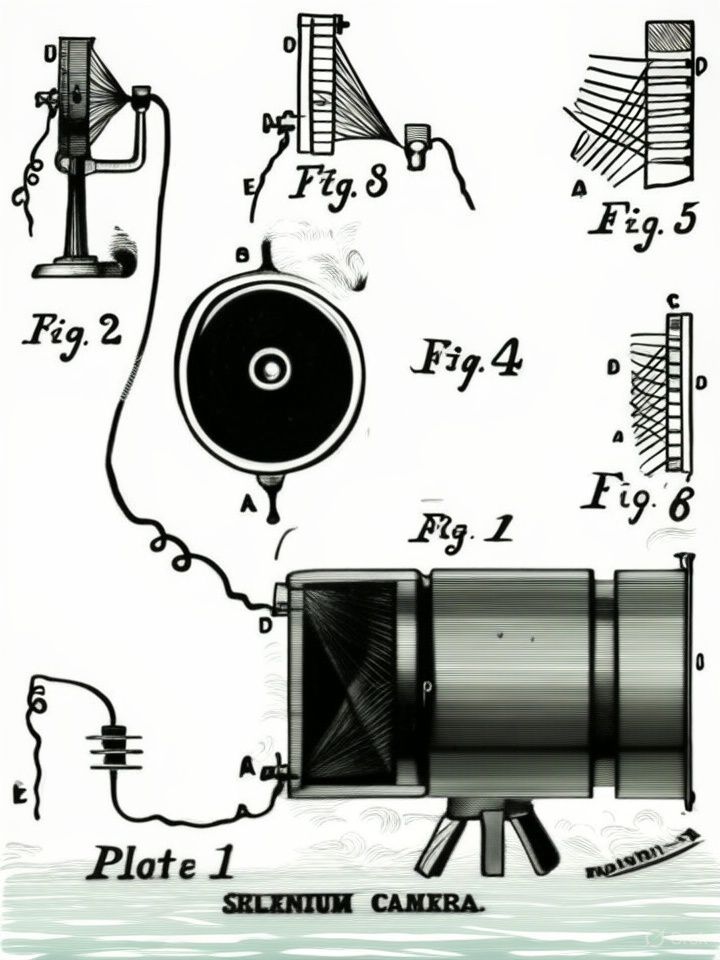
In the annals of electrical innovation, the selenium phototube stands as a remarkable yet underappreciated invention that bridged the gap between early electrical experiments and modern optoelectronic technologies. Developed in the late 19th century, this device harnessed the unique properties of selenium to convert light into electrical signals, laying the groundwork for advancements in imaging, communication, and sensing. Despite its obscurity today, the selenium phototube played a pivotal role in the evolution of technologies like wirephoto systems, early television, and light meters. This article explores the origins, functionality, applications, and legacy of the selenium phototube, shedding light on a forgotten cornerstone of electrical engineering.
## Origins and Discovery
The selenium phototube’s story begins with the discovery of selenium’s photoconductive properties. In 1873, British telegraph engineer Willoughby Smith noticed that selenium, a non-metallic element, exhibited a curious behavior: its electrical resistance decreased when exposed to light. This phenomenon, known as photoconductivity, was a groundbreaking revelation at a time when electricity was still a nascent field of study. Smith’s discovery sparked interest among scientists and engineers, who saw potential in using selenium to create devices that could interact with light in novel ways.
Building on this discovery, the selenium phototube emerged around 1893 as a practical application of selenium’s properties. Unlike earlier selenium cells, which were simple flat surfaces coated with the element, the phototube was a more sophisticated device, often enclosed in a vacuum or gas-filled tube to enhance its sensitivity and stability. The phototube’s design allowed it to generate measurable electrical signals in response to light, making it a precursor to modern photoelectric sensors.
## How the Selenium Phototube Worked
The selenium phototube operated on the principle of photoconductivity, where light exposure alters the electrical conductivity of a material. In its simplest form, the phototube consisted of a selenium-coated electrode (the photocathode) housed within a vacuum or low-pressure gas-filled glass tube, paired with an anode to collect the generated electrical current. When light struck the selenium surface, it excited electrons, reducing the material’s resistance and allowing a current to flow through an external circuit. The intensity of the light directly influenced the strength of the electrical signal, enabling precise measurements of light levels.
The use of a vacuum or gas-filled tube improved the device’s efficiency compared to earlier selenium cells, as it minimized interference from environmental factors like humidity. This design also allowed the phototube to respond more quickly to changes in light, making it suitable for dynamic applications such as image transmission.
## Applications of the Selenium Phototube
The selenium phototube found a wide range of applications in the late 19th and early 20th centuries, many of which were revolutionary for their time:
1. **Wirephoto and Early Fax Systems**: One of the earliest commercial uses of the selenium phototube was in wirephoto technology, the precursor to modern fax machines. In the 1920s and 1930s, wirephoto systems used selenium phototubes to scan photographs and convert their light and dark areas into electrical signals. These signals were transmitted over telegraph or telephone lines and reconstructed at the receiving end, enabling newspapers to share images across long distances rapidly. This technology was a game-changer for journalism, allowing near-instantaneous visual reporting.
2. **Early Television Systems**: The selenium phototube played a role in the development of mechanical television systems, such as those pioneered by John Logie Baird in the 1920s. These systems relied on scanning devices like the Nipkow disk, paired with selenium phototubes, to convert light from a scene into electrical signals for transmission. While mechanical television was eventually replaced by electronic systems using cathode-ray tubes, the phototube’s contribution was critical in proving the feasibility of television.
3. **Light Meters for Photography**: Photographers in the early 20th century relied heavily on selenium phototubes for light meters, which measured ambient light to determine proper camera exposure settings. The phototube’s ability to produce a reliable electrical signal proportional to light intensity made it ideal for this purpose. Selenium-based light meters remained popular until the 1980s, when more advanced semiconductor-based sensors took over.
4. **Scientific and Industrial Applications**: Beyond consumer applications, selenium phototubes were used in scientific experiments and industrial settings to measure light intensity, detect light changes in spectroscopy, and monitor processes requiring precise light detection. Their versatility made them a staple in early electrical engineering laboratories.
## Advantages and Limitations
The selenium phototube offered several advantages that made it a breakthrough technology. Its sensitivity to visible light allowed it to perform tasks that were previously impossible, such as converting images into electrical signals. The device was also relatively simple to construct, making it accessible for early adopters in various fields. Additionally, its ability to operate without external power sources (in some configurations) was a significant benefit in an era when electrical infrastructure was still developing.
However, the selenium phototube had notable limitations. Its response time was relatively slow compared to modern sensors, making it unsuitable for applications requiring rapid changes in light detection. Selenium’s sensitivity was also limited to specific wavelengths, primarily in the visible spectrum, which restricted its use in more specialized applications. Furthermore, selenium phototubes were prone to degradation over time, especially when exposed to intense light or environmental factors, which affected their reliability.
## Legacy and Modern Relevance
By the mid-20th century, advancements in semiconductor technology, such as the development of silicon-based photodiodes and photomultiplier tubes, began to overshadow the selenium phototube. These newer devices offered greater sensitivity, faster response times, and broader spectral ranges, rendering the selenium phototube obsolete for most applications. However, its impact on the history of electrical engineering and optoelectronics cannot be overstated.
The selenium phototube was a critical stepping stone in the development of photoelectric technology, which underpins many modern devices, including digital cameras, solar cells, and optical communication systems. Its role in early image transmission technologies like wirephoto and television helped shape the media landscape of the 20th century. Moreover, the principles of photoconductivity discovered through selenium research continue to inform the design of modern sensors and detectors.
Today, the selenium phototube is largely a historical curiosity, preserved in museums and technical archives. Yet its story serves as a reminder of how incremental innovations can pave the way for transformative technologies. The phototube’s ability to bridge light and electricity opened new frontiers in science and industry, proving that even obscure inventions can leave a lasting legacy.
## Conclusion
The selenium phototube may not be a household name, but its contributions to electrical engineering and technology are undeniable. From enabling the first wirephoto transmissions to powering early television experiments and photographic light meters, this unassuming device played a pivotal role in the evolution of modern optoelectronics. By harnessing the photoconductive properties of selenium, inventors and engineers of the late 19th and early 20th centuries laid the foundation for a world where light and electricity work in tandem to drive innovation. The selenium phototube deserves recognition as a quiet pioneer that helped illuminate the path to our technologically advanced present.


💬 COMMENT