
The Science Behind Light Amplification
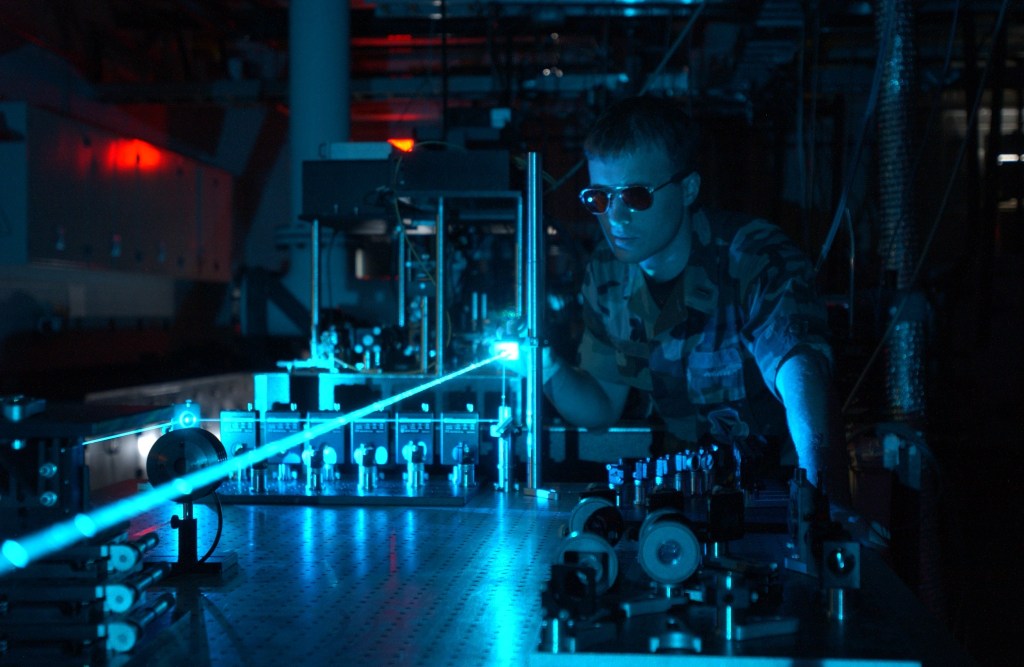
Laser physics is a fascinating branch of science that explores the principles behind the creation and manipulation of lasers—devices that emit coherent, highly focused beams of light with remarkable precision and power. The term “laser” stands for Light Amplification by Stimulated Emission of Radiation, and its discovery has revolutionized technology, medicine, communications, and countless other fields. This article delves into the core concepts of laser physics, including the mechanisms that govern laser operation, their key components, and their wide-ranging applications.
The Fundamentals of Laser Physics
At the heart of laser physics lies the interaction between light and matter. To understand how lasers work, we must first explore a few key concepts from quantum mechanics and optics:
1. Spontaneous and Stimulated Emission: – Atoms in a material can exist in different energy states. When an atom absorbs energy (e.g., from heat or light), its electrons jump to a higher energy level, creating an excited state. When the electron returns to a lower energy state, it releases energy in the form of a photon—a particle of light. This process is called spontaneous emission. – In stimulated emission, an incoming photon interacts with an excited atom, causing it to emit a second photon with the same frequency, phase, and direction as the incoming one. This is the key mechanism that allows lasers to produce coherent light. 2. Population Inversion: – For a laser to function, there must be more atoms in an excited state than in a lower energy state—a condition known as population inversion. This is achieved by supplying energy to the laser medium (a process called “pumping”) through electrical discharges, light, or chemical reactions. – Population inversion ensures that stimulated emission dominates over absorption, allowing the amplification of light.
3. Coherence and Monochromaticity: – Lasers produce light that is coherent, meaning the light waves are in phase, traveling in lockstep with one another. This coherence gives lasers their intense, focused beams. – Laser light is also nearly monochromatic, meaning it consists of a single wavelength or a very narrow range of wavelengths, resulting in a specific color.
Components of a Laser A typical laser consists of three main components:
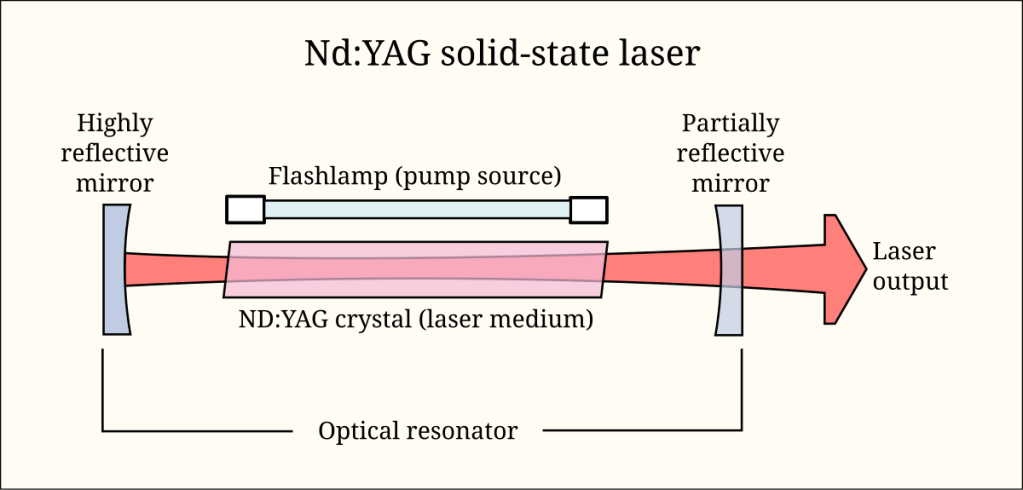
1. Gain Medium: – The gain medium is the material where light amplification occurs. It can be a gas (e.g., helium-neon or CO₂), a solid (e.g., ruby or neodymium-doped yttrium aluminum garnet [Nd:YAG]), a liquid (e.g., dye lasers), or a semiconductor. – The choice of gain medium determines the wavelength and properties of the emitted laser light.
2. Energy Source (Pump): – The pump provides energy to excite the atoms in the gain medium, creating the population inversion necessary for lasing. Common pumping methods include optical pumping (using light, such as from a flash lamp or another laser), electrical pumping (using an electric current), or chemical pumping.
3. Optical Resonator: – The optical resonator consists of two mirrors placed at opposite ends of the gain medium. One mirror is fully reflective, while the other is partially reflective, allowing some light to exit as the laser beam. – The resonator amplifies the light by reflecting photons back and forth through the gain medium, stimulating further emissions and producing a coherent beam.
How a Laser Works
The operation of a laser can be summarized in a few steps:
1. Pumping: Energy is supplied to the gain medium, exciting atoms and creating a population inversion.
2. Spontaneous Emission: Some excited atoms spontaneously emit photons, initiating the process.
3. Stimulated Emission: These photons trigger other excited atoms to emit identical photons, amplifying the light.
4. Resonance: The optical resonator reflects the photons back and forth, further amplifying the light until a stable, coherent beam is emitted through the partially reflective mirror.
Types of Lasers
Lasers come in various forms, each suited to specific applications based on their gain medium and design:
1. Gas Lasers: – Examples: Helium-neon (HeNe) lasers, CO₂ lasers. – Applications: Barcode scanners, cutting and welding, scientific research.
2. Solid-State Lasers: – Examples: Ruby lasers, Nd:YAG lasers. – Applications: Medical procedures (e.g., laser eye surgery), material processing, military targeting.
3. Semiconductor Lasers: – Examples: Diode lasers. – Applications: Optical communication, laser pointers, DVD players.
4. Dye Lasers: – Use organic dyes as the gain medium, allowing tunable wavelengths. – Applications: Spectroscopy, medical diagnostics.
5. Fiber Lasers: – Use optical fibers doped with rare-earth elements as the gain medium. – Applications: High-precision cutting, telecommunications.
Applications of Lasers
The unique properties of lasers—coherence, monochromaticity, and high intensity—make them indispensable across numerous fields:
1. Medicine: – Lasers are used in surgeries (e.g., LASIK for vision correction), cancer treatment, and dermatology for precise tissue removal or tattoo removal.
2. Communications: – Fiber-optic communication relies on lasers to transmit data over long distances with minimal loss.
3. Industry: – Lasers are employed for cutting, welding, engraving, and 3D printing due to their precision and control.
4. Scientific Research: – Lasers enable advanced experiments in spectroscopy, quantum mechanics, and fusion research.
5. Defense and Security: – Lasers are used in rangefinders, missile defense systems, and directed-energy weapons.
6. Consumer Electronics: – Lasers are integral to devices like Blu-ray players, laser printers, and barcode scanners.
Advances and Future Directions in Laser Physics
Laser physics continues to evolve, driven by innovations in materials, design, and applications. Some exciting developments include:
- Ultrafast Lasers: – Femtosecond (10⁻¹⁵ seconds) and attosecond (10⁻¹⁸ seconds) lasers allow scientists to study processes at the atomic and molecular levels, opening new frontiers in chemistry and physics.
- Quantum Lasers: Research into quantum cascade lasers aims to create more efficient and compact laser sources.
Conclusion
Laser physics is a cornerstone of modern science and technology, blending principles of quantum mechanics, optics, and engineering to produce one of the most transformative inventions of the 20th century. From enabling life-saving medical procedures to powering global communication networks, lasers have reshaped our world. As research advances, we can expect lasers to play an even greater role in scientific discovery, industry, and everyday life, pushing the boundaries of what is possible with light. For those interested in diving deeper, exploring topics like nonlinear optics, laser spectroscopy, or quantum optics can provide further insight into this dynamic field. The journey of laser physics is far from over, and its future promises to be as brilliant as the beams it produces.


💬 COMMENT