

The Indian education system has long been criticized for its heavy reliance on theoretical knowledge and rote memorization, which stifles innovation and leaves students without essential practical skills. This focus creates graduates who are often unprepared for real-world challenges, contributing to high unemployment rates and a lack of entrepreneurial spirit. Below, we explore key aspects of this issue, drawing from recent analyses.
Overemphasis on Rote Learning Over Practical Application
A major flaw is the curriculum’s outdated structure, which prioritizes memorization for exams rather than hands-on learning. Less than 10% of the curriculum involves practical learning or student research, leading to a lack of enthusiasm and critical thinking among students. This theoretical bias means students graduate without the ability to apply concepts in professional settings, exacerbating unemployment crises where graduates lack job-ready skills. For instance, many courses fail to include practical applications, driving students to seek education abroad for more experiential programs.
Stifled Innovation and Creativity
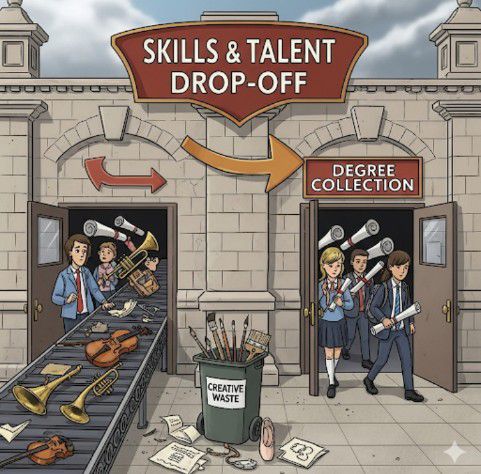
The system’s examination-centric approach discourages individuality and innovation, favoring uniformity and conformity instead. Traditional teaching methods hinder India’s leadership in education by neglecting critical thinking and problem-solving, resulting in a workforce that struggles with innovation. Two critical issues include the lack of quality education and a flawed structure that doesn’t foster creative thinking or activity-based teaching. This is compounded by inadequate teacher training, where educators are not equipped to promote innovative pedagogies.
Infrastructure and Resource Gaps
Many schools, especially in rural areas, lack basic facilities like laboratories and libraries, making practical education nearly impossible. There is also a shortage of trained teachers who can deliver hands-on learning, further widening the gap between theory and practice. Uneven quality across institutions persists, with outdated methods dominating despite reforms like the New Education Policy aiming for more holistic approaches.
Broader Impacts and Potential Solutions
This lack of practical focus contributes to a “rat race” for marks rather than knowledge, leading to mental health concerns and high dropout rates. To address it, suggestions include shifting to activity-based teaching, updating curricula for real-world relevance, and empowering students through practical education initiatives. Without these changes, India risks lagging in global innovation and economic growth.


💬 COMMENT