
When it comes to space exploration, the phrase “rocket science” often conjures images of massive engines spewing fiery exhaust as they launch spacecraft into the cosmos. But what if I told you there’s a quieter, more efficient way to travel among the stars? May be you don’t know about ion propulsion…..
ION PROPULSION is a revolutionary technology that’s transforming the way we think about interplanetary journeys .
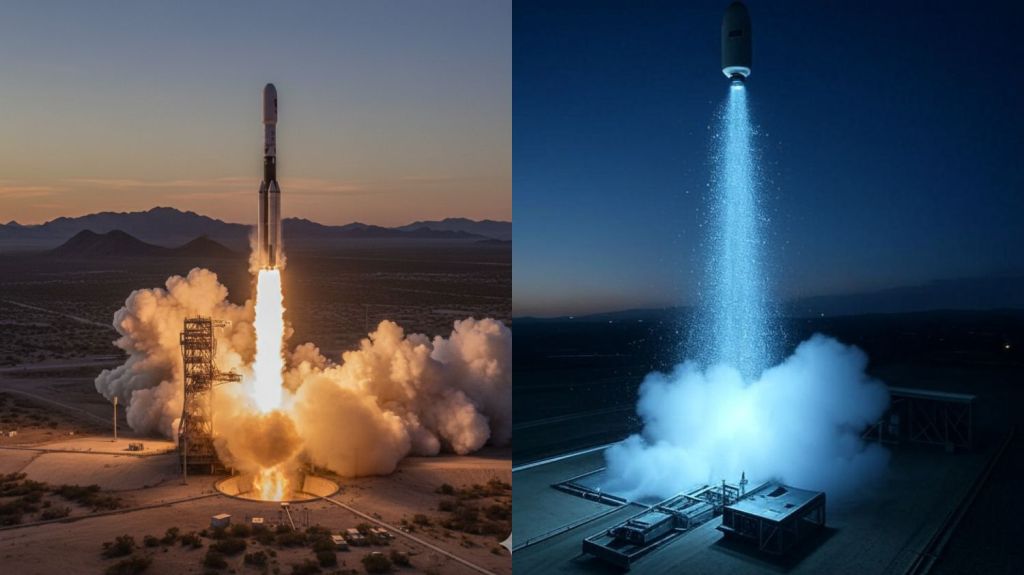
Unlike traditional chemical rockets that burn fuel explosively to generate thrust, ion propulsion systems rely on electrically charged particles, or ions, to create a steady and efficient push through space. This method isn’t about brute force; it’s about precision, endurance, and maximizing efficiency in the vacuum of space. While it might not get you off the ground on Earth, ion propulsion is perfectly suited for the vast, frictionless expanses of space.
First tested in the 1960s, ion propulsion has come a long way, with missions like “NASA’s Dawn spacecraft” showcasing its capabilities. Dawn used ion propulsion to travel to and explore the asteroid belt, visiting “Vesta” and “Ceres”, (read on wikipedia) two of the largest objects in the belt, with unprecedented efficiency.
The magic of ion propulsion lies in its ability to achieve incredibly high speeds over time while consuming far less fuel than traditional rockets. By using electric fields to accelerate ions to extreme velocities, these engines can operate for years without running out of propellant. This makes them ideal for long-term missions to distant planets, asteroids, or even other star systems (in the distant future).
In this article, we’ll explore how ion propulsion works, its advantages 💪 over traditional propulsion methods, and the exciting possibilities it unlocks for the future of space exploration. Are you Ready🚗 to dive into the tech that might one day take us to Mars and beyond? Let’s go! 🚀 (but we have to go through fuel engine 😅)
How Ion Propulsion Works:
Ion propulsion operates on a simple yet futuristic principle: using “”electrically charged particles (ions)”” to generate thrust (read on nasa’s official site) . Unlike traditional rockets that rely on combustion, ion propulsion systems harness “electricity” to accelerate ions to extreme speeds, creating a steady and efficient push.
These are conditions causing ion propulsion
1. Ionization of Gas
The process starts with a propellant—most commonly “xenon gas”. Xenon is chosen because it’s inert, non-corrosive, and has a heavy atomic structure, which makes it ideal for generating thrust. Inside the ion propulsion engine, xenon atoms are bombarded with electrons using an “electron gun”. This interaction knocks electrons off the xenon atoms, turning them into positively charged ions.
2. Acceleration of Ions
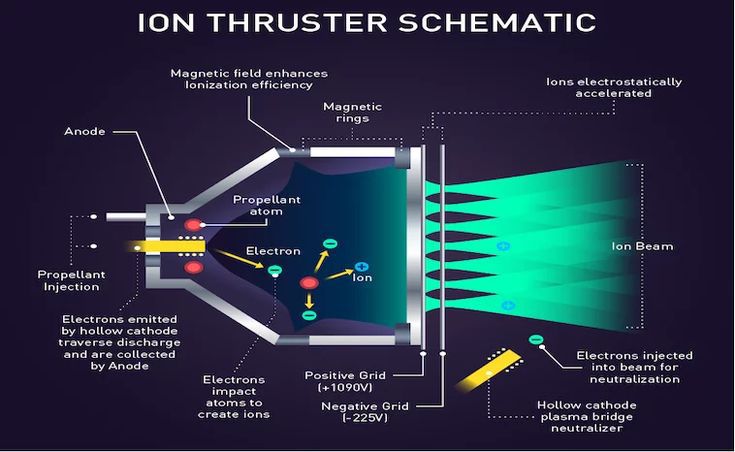
Once the xenon atoms are ionized, they are accelerated using “electric fields”. The engine contains two grids:
– “The positively charged grid” repels the ions.
– “The negatively charged grid” attracts them.
This creates a strong “electrostatic force”,(read on science fact) which propels the ions out of the engine at speeds of ‘30,000 to 90,000 miles per hour’. The result? A high-velocity stream of ions shooting out into space.
3. Thrust via Newton’s Third Law

As the ions are ejected from the engine, they create thrust according to “Newton’s Third Law”: _For every action, there is an equal and opposite reaction._ The spacecraft is pushed forward by the expulsion of ions, and while the thrust generated is small (equivalent to the weight of a piece of paper), it’s incredibly efficient and can be sustained for months or even years.
4. Power Source
Ion propulsion systems need a constant supply of electricity to ionize and accelerate the gas. This electricity usually comes from “solar panels” on the spacecraft. For deep-space missions, where sunlight is weaker, “nuclear power sources” are considered to generate the required energy.
Why Ion Propulsion Rocks in Space
In the vacuum of space, there’s no air resistance, so even the small thrust produced by ion propulsion builds up over time, allowing spacecraft to reach incredible speeds. Unlike chemical rockets that burn through fuel in a matter of minutes, ion engines sip fuel sparingly, making them perfect for long-duration missions to distant planets, asteroids, and beyond.
Ion propulsion is the tech that makes missions like NASA’s *Dawn spacecraft* possible, enabling it to visit multiple celestial bodies in one trip. It’s not just efficient—it’s futuristic, paving the way for interplanetary and interstellar exploration.


💬 COMMENT