
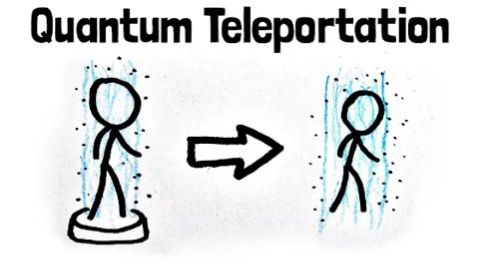
As pondered in a popular Instagram reel by Max Williams, “Can we actually teleport?” the concept has long captivated human imagination, blending the realms of science fiction and cutting-edge physics. While beaming aboard a starship remains a staple of stories like Star Trek, real-world teleportation exists in the quantum domain, where information zips across distances without traversing space. This article delves into the history, science, experiments, challenges, and future of teleportation, drawing on established research to separate fact from fantasy.
The Historical Roots of Teleportation
The idea of instantaneous transport predates modern science, appearing in ancient myths and folklore where gods or magicians vanished and reappeared elsewhere. However, teleportation as a scientific or pseudo-scientific concept emerged in the 19th century. One of the earliest fictional accounts is Edward Page Mitchell’s 1877 short story “The Man without a Body,” where a scientist transmits a cat via telegraph wire, only for mishaps to ensue.
This predates more famous tales, such as Fred T. Jane’s 1897 parody “To Venus in Five Seconds,” which used teleportation to whisk characters across planets.
By the mid-20th century, teleportation entered popular culture through television and film. The iconic “transporter” in Star Trek, introduced in the 1960s, popularized the notion of disassembling and reassembling matter at the atomic level.
This device, often depicted with shimmering effects and a signature hum, was a budget-saving plot tool for the show’s creators but sparked real philosophical debates about identity and continuity.
Earlier claims of real teleportation, like the alleged 1583 disappearance of Dr. John Dee from England to Prague, were likely apocryphal or exaggerated, rooted in alchemy rather than physics.
The shift from fiction to theory occurred in the quantum era. In 1992-1993, physicists Charles H. Bennett, Gilles Brassard, Claude Crépeau, Richard Jozsa, Asher Peres, and William K. Wootters proposed quantum teleportation—a method to transfer a particle’s quantum state to another distant particle without physical movement.
This breakthrough, published in 1993, marked teleportation’s entry into legitimate science.
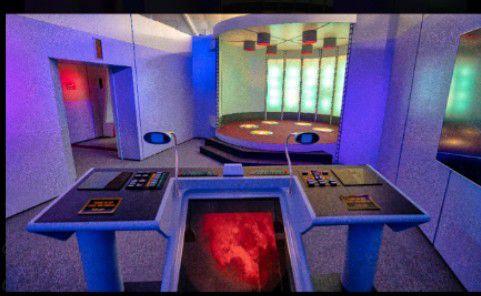
The iconic Star Trek transporter room, a fictional depiction that has influenced real scientific discussions on teleportation.
The Science Behind Quantum TeleportationUnlike sci-fi portrayals where entire bodies dematerialize and rematerialize, quantum teleportation involves transferring information, not matter.
At its core is quantum entanglement, a phenomenon Albert Einstein famously called “spooky action at a distance.” When two particles are entangled, measuring one instantly affects the other, regardless of separation.
The process works like this: Alice (the sender) has a qubit (quantum bit) whose state she wants to teleport to Bob (the receiver). They share an entangled pair of qubits. Alice performs a Bell-state measurement on her qubit and the one to teleport, collapsing their states. She sends the classical results to Bob via conventional means (like light signals). Bob then applies corrections to his entangled qubit, reconstructing the original state.
Importantly, the original qubit is destroyed in the process, adhering to the no-cloning theorem of quantum mechanics.
This isn’t faster-than-light travel—classical communication is required, limited by the speed of light—but it enables secure information transfer, crucial for quantum computing and cryptography.
Related concepts include quantum energy teleportation, where energy is extracted from the vacuum without direct transfer.
Key Experiments and Milestones
The first experimental demonstration came in 1997, when Anton Zeilinger’s team in Austria teleported a photon’s quantum state over a short distance.
This paved the way for longer-range feats, such as a 2017 experiment teleporting information between ground stations and a satellite 1,400 kilometers away.
Recent breakthroughs have pushed boundaries further. In 2020, researchers at the University of Rochester and Fermilab achieved high-fidelity teleportation over 44 kilometers using fiber optics.
By 2024, Northwestern University demonstrated teleportation over busy internet cables, overcoming noise interference.
In 2025, scientists teleported a single photon’s polarization between distant quantum dots for the first time, using separate sources.
Oxford’s 2025 work on logical quantum gates between processors hints at scalable networks.
Japanese researchers even teleported three photons simultaneously, advancing multi-particle systems.
These experiments confirm teleportation’s viability for data, but matter teleportation remains elusive.
Challenges in Achieving Human Teleportation
Scaling quantum teleportation to humans faces insurmountable hurdles. The human body comprises about 7 octillion atoms (7 × 10^27), each with quantum states that must be perfectly scanned and reconstructed.
The Heisenberg uncertainty principle makes precise measurement impossible without altering the state.
Decoherence—quantum states collapsing due to environmental interactions—further complicates matters.
Energy demands are staggering: Disassembling and reassembling a person might require energy equivalent to a nuclear bomb.
Philosophical issues arise too—would the teleported “you” be the same person, or a copy? This “continuity paradox” questions identity.
Ethical concerns, like potential misuse for surveillance or duplication, add layers of complexity.
While some speculate mind uploading or wormholes could enable it, these remain speculative.
The Future of Teleportation TechnologyQuantum teleportation’s future lies in practical applications, not human travel. It could revolutionize quantum networks, enabling unhackable communication via quantum key distribution.
Breakthroughs like 2024’s noise-resistant teleportation over existing infrastructure bring quantum internet closer.
In computing, teleportation links distant processors, scaling quantum machines beyond current limits.
Optimists predict a “quantum internet” by 2030-2040, transforming data security and simulation capabilities.
For human teleportation, it’s science fiction for now, but advances in quantum control might one day blur the lines.
Conclusion
Teleportation, once dismissed as impossible, is a tangible quantum reality for information transfer. From 19th-century tales to 21st-century labs, it embodies humanity’s quest to conquer distance. Yet, as Max Williams’ reel implies, true matter teleportation—let alone for humans—demands breakthroughs that challenge physics’ foundations. For now, it inspires innovation in quantum technologies, promising a connected future where data, if not people, can “beam” across the globe.


💬 COMMENT