
*Introduction*
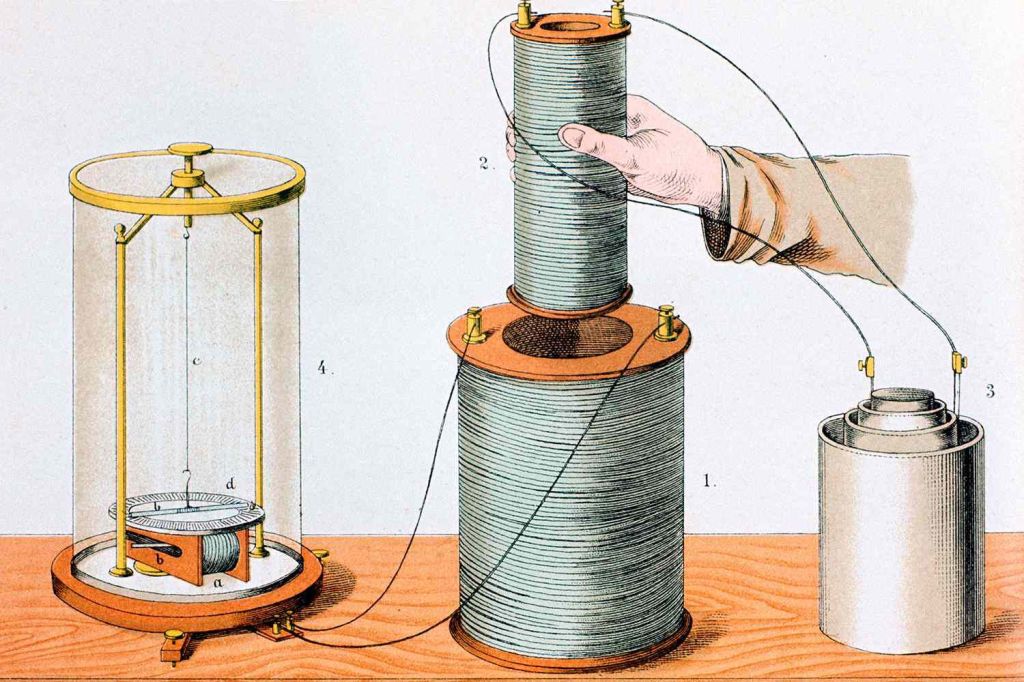
Electromagnetic induction is a fundamental principle in physics where a changing magnetic field within a closed loop induces an electric current in the conductor. This phenomenon was discovered by Michael Faraday in 1831 and is a cornerstone of many electrical technologies, including transformers, generators, and induction motors.
*Basic Principle*
When a magnetic field through a loop of wire changes, an electromotive force (EMF) is induced in the loop. The change in the magnetic field can be due to the movement of the loop in a magnetic field, movement of a magnet near the loop, or a change in the current of a nearby coil. The induced EMF causes a current to flow if the circuit is closed.
*Faraday’s Law of Induction*
Faraday’s law states that the magnitude of the induced EMF ($\mathcal{E}$) is proportional to the rate of change of the magnetic flux ($\Phi_B$) through the loop. Mathematically, this is expressed as:
$$\mathcal{E} = -\frac{d\Phi_B}{dt}$$
where $\Phi_B = \mathbf{B} \cdot \mathbf{A}$, with $\mathbf{B}$ being the magnetic field and $\mathbf{A}$ the area vector of the loop. The negative sign indicates the direction of the induced EMF opposes the change in flux (Lenz’s law).
*Lenz’s Law*
Lenz’s law states that the direction of the induced current is such that the magnetic field it produces opposes the change in the original magnetic flux. This is a consequence of the conservation of energy.
*Applications*
– *Transformers*: Use electromagnetic induction to transfer energy between coils with different turns, allowing voltage step-up or step-down.
– *Electric Generators*: Convert mechanical energy to electrical energy via induction in rotating coils within magnetic fields.
– *Induction Motors*: Use induced currents to generate torque for rotation.
*Summary*
Electromagnetic induction is a critical phenomenon where changing magnetic fields induce currents in conductors. Understanding this principle is key to the operation and design of many electrical devices.


💬 COMMENT