
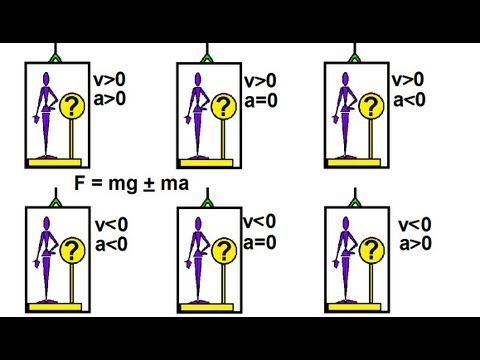
When you step into a lift and it begins to move, you experience a change in your apparent weight. This is because the normal force—the force exerted by the lift floor on your feet—changes as the lift accelerates or decelerates. Your true weight is the constant force of gravity pulling you down, but your apparent weight is the reading you’d get from a weighing scale inside the lift. This apparent weight is equal to the normal force.
Condition 1: Lift at Rest or Moving with Constant Velocity
When the lift is either stationary or moving at a constant velocity, the net force on you is zero. According to Newton’s First Law of Motion, an object will remain at rest or in uniform motion unless acted upon by a net force. In this case, the upward normal force (N) from the floor is perfectly balanced by your downward weight (W).
* Equation: N = W = mg
* Apparent Weight: Your apparent weight is equal to your true weight. You feel your normal weight.
Condition 2: Lift Accelerating Upwards
As the lift starts moving upwards, it accelerates. During this phase, the normal force (N) is greater than your weight (W). This is because the floor needs to not only support your weight but also provide an additional upward force to accelerate you.
* Equation: N – W = ma- Result:N = W + ma = m(g + a)
* Apparent Weight: Your apparent weight is greater than your true weight. You feel heavier. This sensation is often noticeable as a slight pressure on your feet.
Condition 3: Lift Decelerating Upwards
When the lift is moving upwards and begins to slow down to stop at a higher floor, it is decelerating. Deceleration is essentially acceleration in the opposite direction of motion, so the acceleration vector is pointing downwards. In this case, the normal force (N) is less than your weight (W).
* Equation: W – N = ma- Result:N = W – ma = m(g – a)
* Apparent Weight: Your apparent weight is less than your true weight. You feel lighter. This is the sensation of “lift” that you feel as the lift slows to a stop.
Condition 4: Lift Accelerating Downwards
As the lift starts moving downwards, it accelerates in the downward direction. Here, the net force is downwards, which means your weight (W) is greater than the normal force (N).
* Equation: W – N = ma- Result:N = W – ma = m(g – a)
* Apparent Weight: Your apparent weight is less than your true weight. You feel lighter. This is the same sensation as when the lift decelerates upwards.
Condition 5: Free Fall of the Lift
This is an extreme and hypothetical condition where the lift’s cable snaps and it falls freely. In this scenario, the only force acting on you is gravity, and both you and the lift are accelerating downwards at the rate of gravity (g). The normal force (N) from the floor becomes zero because the floor is falling at the same rate you are.
* Equation: W – N = mg- Result:mg – N = mg \Rightarrow N = 0
* Apparent Weight: Your apparent weight is zero. This is a state of weightlessness. You would feel as if you are floating inside the lift. This is a similar principle to how astronauts experience weightlessness in orbit.


Leave a Reply to Lift – Dushyant Kumar Cancel reply